Showing posts with label Classroom activities. Show all posts

Thursday, April 7, 2011

Claymation


This is a compilation of the "Claymation" project my Grade 2 students made. I showed them a video of clay animation of animals as we talked about life cycles during the third term. To assess what they learned in class, I instructed them to produce some clay animation to show the life cycle of the animal of their choosing. They worked in groups, most of them dividing the work among each other according to the stages of a particular animal's life cycle. I took photos of each of the group's outputs and flashed them one after the other during the next class for the "animation effect".

As what I have mentioned, a teacher has to consider the learner's motivation to make the most out of learning, as well as their abilities and interest. From the moment I showed the clay animation video, they were already hooked (they all thought it was so cool, their eyes were glued to the screen) and I knew I had a promising classroom activity at hand. Admittedly, I chose to show the video just because it was very cute and it was initially a supplement to my lesson. Preparation and quick thinking indeed paid off, and this goes to show that a teacher should always be on the lookout for the best avenue for learning. It doesn't come naturally, but with experience.

Not only were they very responsive and inquisitive during our class discussions, they were all engrossed in making their clay figures as accurate as possible. Everybody was busy, nobody was unruly, and they seldom asked for my help because the task was very well within their capabilities. At the time that I showed them the "animation", everyone looked so proud of themselves. It made me feel good, too, that I somehow contributed positively to their self-esteem.

These are just one of the many highlights of my first year of teaching these children. More than their shower of affection for me, it's seeing them enjoy and bask in their learning that is most rewarding for me. At such a young age, school should never be a burden to these children, because they still have several years of school ahead of them and they should find it worthwhile going through it.

Wednesday, April 6, 2011

GRASPS Grade 1

I discussed with the first graders Materials, Light and Air during the second term. For their GRASPS project, they were tasked to create a model house that utilizes air and sunlight in the most efficient way. They are to take the role of an architect that is part of a design team of a real estate company and their model house is to be showcased in mall kiosks to potential home buyers. They are to use durable building materials such as clay, popsicle sticks, cardboard, and the like that can make it stand until exhibit day.

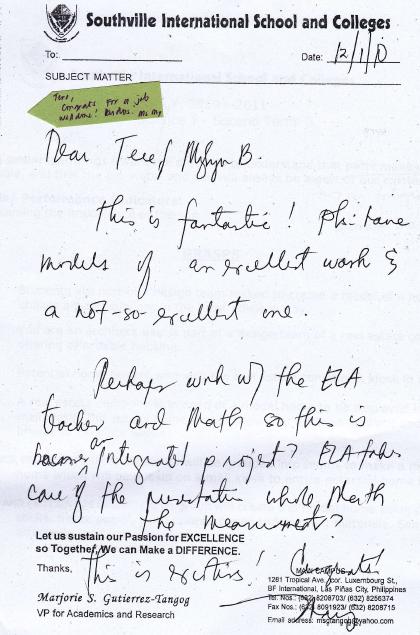
Again, my proposal received positive feedback from Ms. Marj :) It is indeed nice to have some kind of integration with other subjects for the next academic year.


It was a real challenge to facilitate sessions where the groups worked on it. Some refused to work in groups, others were heavily dependent on my help, and there were several instances where children were playing with the scissors, destroying other groups' work, hiding some materials, and playing the popsicle stick game. It took a while for them to finish of course. It is sad that photos of their finished work has been accidentally deleted :(

It really does take a lot of patience working with children this age. But then again, you can expect more output from them than preschool children. However, there are a lot of aspects to be managed and facilitated because they are also capable of more mischief. At some point I did think about making projects individual to prevent rifts between groupmates due to lack of cooperation and other things, but then again, with individual projects you have to contend with other people making their project, late submission or no submission at all.

GRASPS Grade 2

GRASPS is a performance task implemented every term that stands for the following:
G - goal
R - role
A - audience
S - situation
P - product
S - score

These actually describes what the project is about, what the students are expected to do, and how they will be assessed. During the second term, the Grade 2 classes covered Basic Food Groups.

To assess the students on their knowledge of healthy food, I asked them to pretend they are about to open a healthy restaurant and they will have to plan their menu offerings. I required them to name their healthy dishes, add a description and determine the price. I planned to assess them according to neatness, organization, content and punctuality of submission.

This proposal received positive feedback (Thanks so much, Ms. Marj, you really made my day that time!) I knew this can turn out to be very promising. The suggestions would be ideal for the next academic year.


I gave the students ample time for their project and here is one of the many excellent projects I received:


I was initially thinking of something that will make the students engaged and not resort to asking their parents to do it for them. I patterned this against the Facebook game Restaurant City where one has to collect certain ingredients to prepare a dish. I gave higher grades to those that were obviously made by them. There were still some students who had to be reminded several times to submit and only managed to cut out pictures of food from magazines without any description nor price.

Admittedly, I could have prepared better for this project, by showing them a finished product rather than merely describing and drawing it on the blackboard. Also, it would have been helpful to dedicate one session to help them work on it, also to make sure that each one already started with the project. I have to be aware of the time constraints and maybe it would have been better if I started this project in the middle of the term rather than the last three weeks.

Tuesday, April 5, 2011

PLED and DCIA

It amazes me really how SISC manages to come up with so many acronyms, but I have to admit it helps a great deal in remembering what they are for.

Every term, students evaluate each teacher according to certain measures stated in the Positive Learning Environment and Discipline which covers the following:
a. positive teacher expectations for student success
b. physical classroom readiness
c. planning and implementation of the work plan
d. procedures and rules
e. punishments, consequences and rewards
f. classroom management
g. instruction and assessment of learning

Aside from that, teachers are also evaluated on their implementation of Differentiated Curriculum, Instruction and Assessment in the classroom, which is basically about catering to children's different needs and preferences and making room for children learning at a different pace.

You can always count on children to be honest, and I'm very thankful that they perceive me to be such, according to their evaluation of me for the last three terms:


I feel honored that throughout the terms, their rating consistently increased, albeit with minute intervals. For the first and second term, I realized I should not rest on my laurels despite the high ratings because one wrong move can be something that most children might remember forever.

Admittedly, classroom management has been my waterloo because I realize that all my classroom concerns is basically rooted from there. Not that I'm making excuses, but it is a far cry from what I've been used to when I taught preschool for 5 years. I never had to be too firm, instead I continuously have to be loving, nurturing and patient, which unfortunately, no longer work for children this age. I tried some strategies throughout the year but they all end up to be temporary solutions only. For the coming academic year, I resolve to be more firm in my ways.